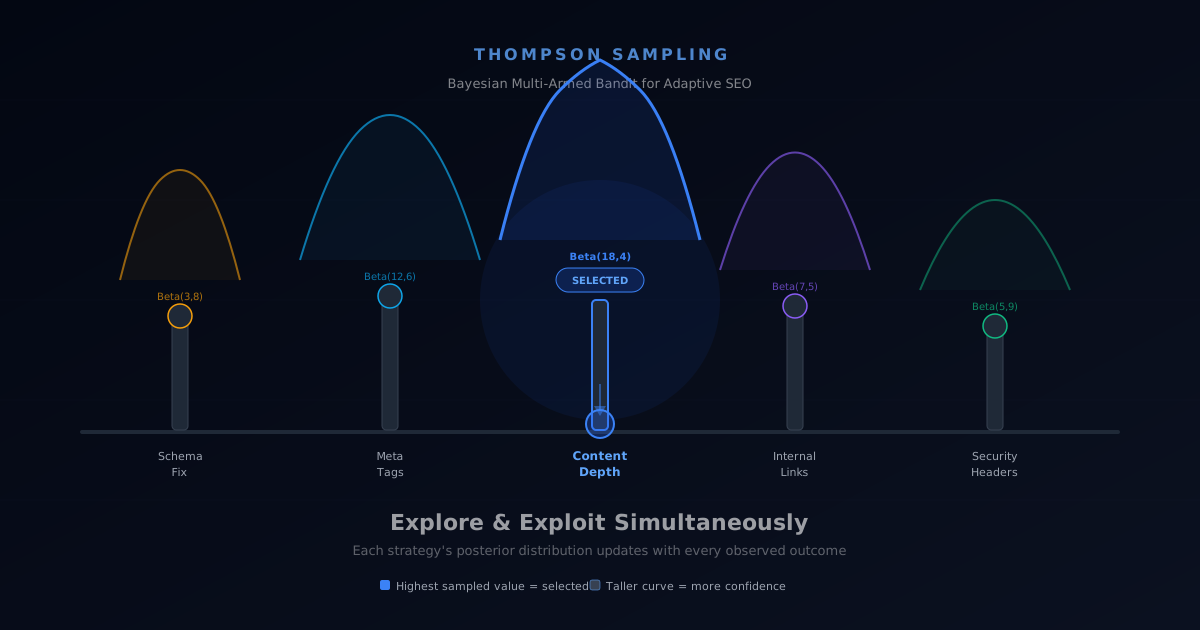
The Decision Problem
A website can have several legitimate issues at once: missing structured data, weak titles, incomplete image text, thin content, or technical defects. A rules engine can identify those conditions, but a separate question remains: which eligible action should be considered first?
That ordering question contains uncertainty. A responsible system should preserve the candidate set, explain why each candidate is eligible, record the choice it made, and avoid converting a later correlation into a causal success claim.
What Is Thompson Sampling?
Thompson Sampling is a Bayesian approach to the multi-armed bandit problem. Given several options with uncertain reward rates, it samples once from each option's current probability distribution and chooses the highest sample. This balances exploration of uncertain options with use of options whose stored state is more favorable.
The Beta-Binomial Model
For a binary reward, an option can be represented by a Beta distribution with two parameters, alpha (α) and beta (β). In a textbook feedback loop, an eligible success changes alpha and an eligible failure changes beta. The important word is eligible: an observation should not alter the model unless the intervention, baseline, outcome window, coverage, and attribution rules make that update defensible.
Sampling is a selection mechanism. It becomes an evidence-based feedback system only when every model update is causally eligible and applied exactly once.
What ClickRadius Currently Implements
The current ClickRadius Strategy Engine contains a real sampling path, but its production boundary is narrower than the former marketing language suggested.
- Configured arms: active optimization strategies are stored by context with configured alpha, beta, parent-state, and observation thresholds.
- Candidate ordering: the batch auto-fix path samples eligible arms and selects up to three mapped fix strategies.
- Decision evidence: each choice records its sampled value, competing samples, context, and any grounded citation baseline available at decision time.
- Confounding quarantine: because the normal batch creates several same-site decisions together, the scheduled observer treats them as mutually confounded and records them without training.
Why Customer-Outcome Training Is Not Currently Active
A before-and-after citation-rate change is not enough to identify what caused it. Several fixes may have been deployed together; the query mix or engine behavior may have changed; the baseline may be absent; or a retry may attempt to apply the same reward twice. The current normal batch path is explicitly quarantined when its same-site decisions overlap.
A separate admin outcome endpoint can call the update function without the scheduler's complete eligibility checks, and the update path does not yet enforce an exactly-once reward transition. Until every writer shares one causal eligibility contract, ClickRadius does not present customer-outcome training as an active capability.
The Activation Contract
Before outcome evidence may change strategy state, the completion plan requires:
- a stable intervention identity, treatment scope, target, and verified effect receipt;
- a predeclared outcome plus baseline and measurement windows;
- overlap and confounding checks based on actual treatment windows;
- minimum sample and coverage eligibility, with unavailable data kept distinct from zero;
- the same gate for scheduled, admin, and manual writers;
- an atomic exactly-once state transition with replay and concurrency proof; and
- holdout or comparison evidence where feasible, plus drift and rollback controls.
What This Means in the Product Today
Strategy sampling may help order eligible auto-fix candidates, and the resulting records provide an audit trail for later evaluation. It does not prove that the selected strategy was best, that a deployment caused a citation change, or that ClickRadius has trained a site-specific optimization model.
This boundary is deliberate. Preserving uncertainty is more useful than a confident but unsupported success label: it protects customers from automated decisions trained on confounded or duplicated evidence and gives the future feedback system a trustworthy foundation.
Get your free AI Readiness Score to inspect the evidence ClickRadius can measure today. Strategy decisions and outcome observations remain separately traceable, and customer-outcome training stays inactive until its causal release gate passes.