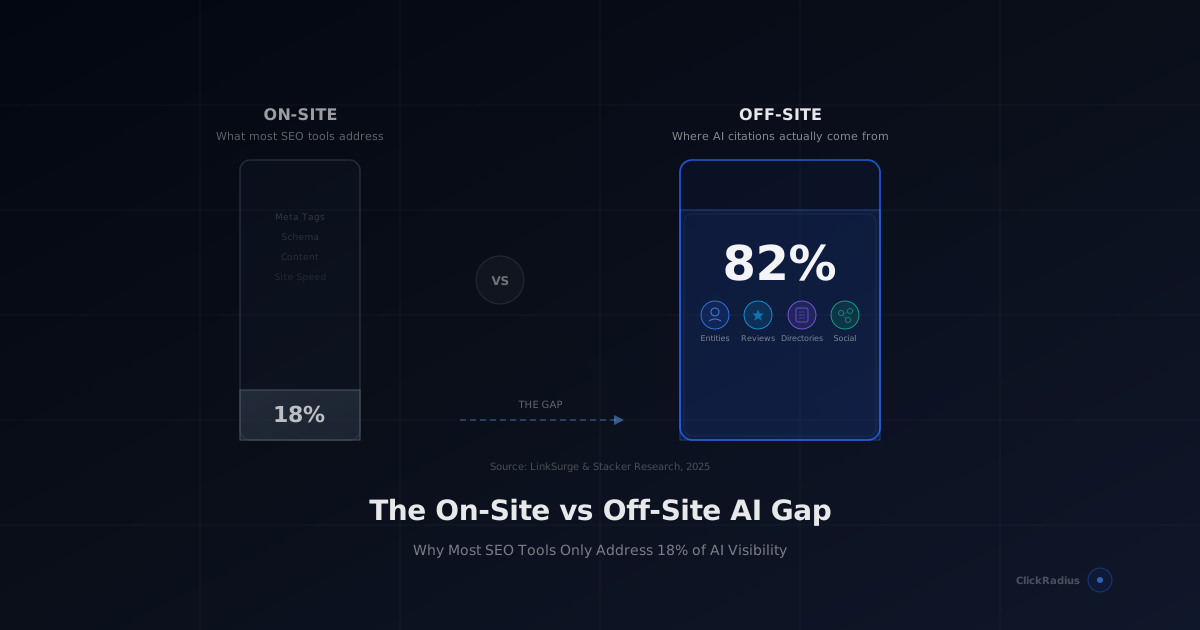
Why Two Evidence Surfaces Matter
AI systems can encounter a business through its own website and through independent sources across the wider web. Those surfaces answer different questions: the website states first-party facts and provides crawlable content, while external profiles, reviews, directories, and editorial references can corroborate identity, reputation, and context.
No reviewed evidence establishes one universal percentage that applies across engines, query sets, industries, and time windows. A defensible analysis measures the two surfaces separately and reports the population and observation window.
A website crawl can inspect title tags, metadata, headings, content, delivery, internal links, and structured data. An off-site inventory inspects records controlled by other publishers. Neither surface alone reveals an engine's private ranking, retrieval, or generation weights.
AI engines may draw on sources across the web, not just the business's website. Which sources matter, and by how much, varies with the engine, query, retrieval mode, and available evidence.
What “Off-Site” Actually Means in AI Context
Backlinks are one familiar off-site record. Local profiles, reviews, directory entries, independently authored coverage, and public organizational records have different publishers, subjects, correction paths, and evidentiary value.
The useful task is to inventory those records without claiming which undisclosed inputs an engine used or how much weight it assigned:
Entity Presence Across Knowledge Platforms
An entity record represents an identifiable subject such as a person, organization, place, product, or service. A publisher can reconcile names, identifiers, locations, relationships, and sources; that does not establish how a particular engine resolves the subject or whether it will recommend it.
Examples to consider in an entity-record inventory, only where applicable:
- Wikidata — Use only for eligible subjects and source each statement under Wikidata's current policies; existence there is not a provider-outcome guarantee.
- Google Business Profile — Check claimed business facts, category, hours, and ownership state under Google's current profile rules.
- Apple Business Connect — Check whether the organization is eligible to claim and maintain the corresponding Apple place record.
- Data Axle — Treat a submission, provider acceptance, and public listing as three separate states.
- Yelp — Separate owner-supplied business facts from reviews and other user-contributed material the business does not control.
NAP Consistency
Record each name, address, and phone value together with the location or department it describes, its source, owner, and effective date. A mismatch may be an error or a legitimate alias, tracking number, or location-specific value. Reconcile real conflicts for factual accuracy without inventing an engine confidence score.
Review Signals
Reviews are third-party or user-contributed records whose content, dates, platform, and moderation state can be inspected. A captured answer may visibly cite or quote a review source, but the public response does not reveal whether review count, sentiment, recency, or another attribute affected selection.
If every visibility decision is based only on a website audit, external identity and corroboration evidence remains unobserved. That is a measurement blind spot, even when the website work itself is valuable.
Social Media Presence
Social profiles are separately controlled public records. Record the exact profile, claimed owner, statements, publication date, and observable engagement without presenting follower count, posting frequency, or message consistency as a universal AI-selection signal.
Mentions on Authoritative Sites
A news story, industry article, local report, award record, or professional directory entry can be retained as independently published evidence. It does not prove ingestion, entity resolution, an engine authority score, or a later answer effect; measure those states separately.
Content Syndication
Republished or syndicated material needs provenance: original publisher, author, publication and modification dates, canonical relationship, editorial control, and each public URL. Multiple copies do not by themselves establish independent corroboration or an engine effect.
Why Website-Only Tools Leave Blind Spots
A website crawler and an off-site evidence inventory answer different questions. A crawl can inspect first-party pages and links. It cannot, by itself, establish ownership, accuracy, or current state across independent publishers, nor can either audit prove which sources a particular AI response used.
Product capabilities and third-party integrations change over time, so this article does not make categorical claims about competing tools. Evaluate each product against its current documentation and a fixed acceptance test for the records and observations the organization actually needs.
The Full Spectrum: How ClickRadius Addresses the Gap
The current ClickRadius workflow separates three evidence lanes:
Layer 1: Entity Orchestrator (Off-Site)
The Entity Orchestrator reads selected facts from the site's published entity markup while preserving higher-authority client-confirmed or CRM values. Eligible Data Axle, Foursquare, and Bing Places actions enter a reviewable queue; other directory work may remain a manual checklist. Drafted, queued, provider-accepted, publicly observed, skipped, and failed states remain distinct.
Layer 2: Outside Signals (Off-Site)
The Outside Signals lane stores source-bound observations and can prepare eligible recommendations or outbound work under the applicable authority and destination contract. An absent or low rubric input does not predict a citation outcome, and prepared work is not reported as published or publicly observed.
Layer 3: On-Site Optimization (On-Site)
The on-site layer evaluates schema markup, metadata, content structure and technical findings, then prepares eligible corrections. ClickRadius's auto-fix engine applies a supported effect only with current authorization for the exact revision and a verified capable connection; otherwise the work remains for review or customer implementation. A provider receipt and an independent public-origin observation are recorded separately.
The combination of all three layers provides broader evidence coverage. Addressing the website alone leaves external corroboration unmeasured. Addressing off-site presence alone misses the first-party content quality and technical access a source needs. Both surfaces matter, but their relative contribution must be observed rather than assumed.
The Strategic Implication
If an SEO program invests only in content creation, technical audits, meta tags, and site speed, it may improve the first-party source while leaving inaccurate profiles, conflicting business facts, weak independent references, or missing citation evidence unaddressed. Budget allocation should follow measured gaps, not a universal ratio.
This is not an argument against on-site work. Accurate pages, applicable schema markup, technical access, and useful content have direct publisher value. External records may expose additional factual conflicts or corroboration. Neither surface is a proven universal prerequisite or sufficient cause of an engine mention or citation.
Measure first-party pages, independently published records, and engine answers as separate evidence surfaces. Do not turn completeness on one surface into a claim about another.
Allocate work from measured gaps, factual risk, customer importance, and the authority to change each surface. A citation is one dated observation; it does not prove training-data inclusion, reinforcement, persistence, or competitive displacement.
No retained market-wide prevalence result establishes that a competitive window is open or closing. Start now only for the direct benefit of an earlier baseline and more time to complete approved, supportable work.
Ready to inspect the current evidence? Start a free AI Readiness Score.