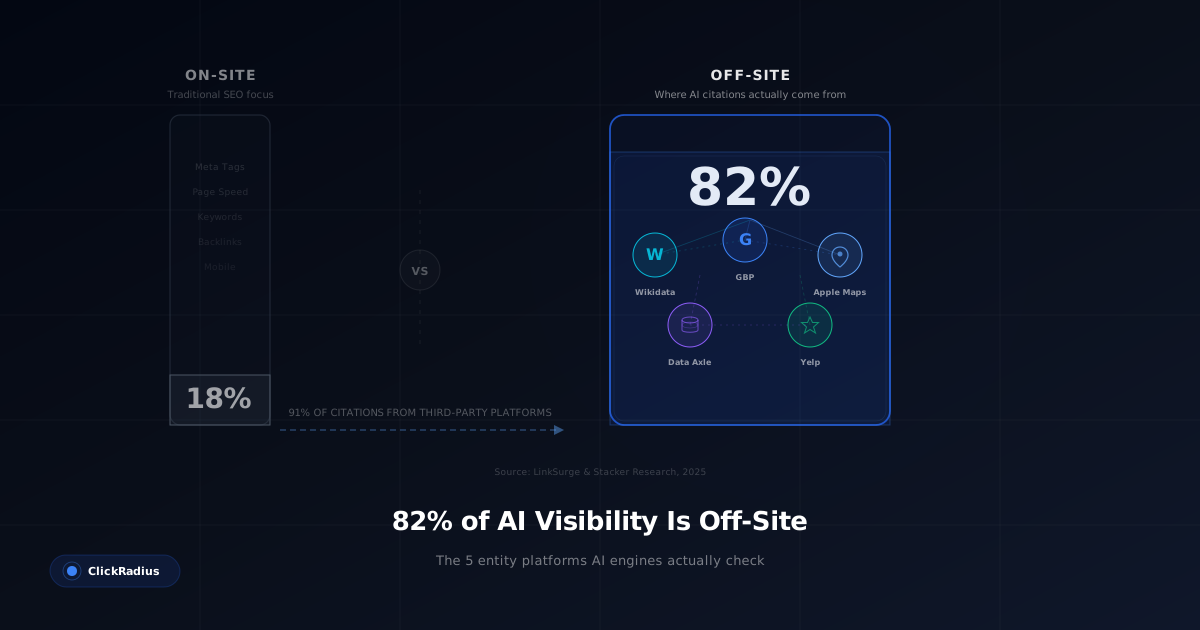
A site crawl can inspect first-party evidence such as metadata, structured data, content, links, response behavior, and crawler policy. It cannot establish the state of every independently controlled business record or what an external answer product returned.
AI-generated answers broaden the evidence surface. Depending on the engine and query, a response may draw on first-party pages, search indexes, structured knowledge bases, independent publications, directories, and community sources. A site audit therefore answers only part of the visibility question.
The practical task is to make first-party facts clear, keep independent records accurate, and observe what each supported engine actually returns. Those are separate jobs and must be measured separately.
Two Evidence Surfaces, Not One Universal Ratio
A website is the publisher-controlled source for its own facts and content. Separately controlled profiles, directories, editorial mentions, and reviews answer different questions. Neither surface can stand in for the other, and conventional search has never been limited to one engine or one evidence type.
An answer product may return a business, a source, several options, an ordinary search or map result, or no usable answer. Its public response does not reveal every source considered or how each input was weighted. Measure the returned answer and visible sources; do not infer a hidden cross-reference process from the output.
External studies use different engines, prompts, samples, and collection windows, so their percentages cannot be combined into one universal on-site/off-site formula. The defensible conclusion is narrower: first-party optimization and independent corroboration are distinct evidence surfaces, and observed citation outcomes must remain engine-, query-, and time-bound.
In plain terms: an organic rank, an indexed profile, an external mention, and an observed AI citation are different facts. None should be substituted for another.
Five Records to Evaluate When Relevant
Off-site review begins by identifying records that actually apply to the business. The five surfaces below are examples, not a checklist every business must complete and not a guaranteed citation recipe. Eligibility, ownership, relevance, and editorial control differ by platform.
1. Wikidata
Wikidata is a public structured knowledge base with community-governed notability requirements. Do not create a business item merely for promotion: first establish that the entity satisfies current policy and that serious public references support its statements. Neither Wikidata nor Wikipedia is a guaranteed route into an AI answer. See the entity-record audit playbook.
2. Google Business Profile
Google Business Profile is a public identity record for businesses that satisfy Google's eligibility and ownership rules. Google says only owners or authorized representatives may verify and manage profile information; a third party needs the owner's express consent. Accurate profile facts are useful customer-facing evidence, but they do not establish a fixed AI-citation score or outcome.
3. Apple Maps
Apple Business Connect lets a business manage how its information appears across supported Apple surfaces. Review the current company and location records under the business's authority. A material conflict in customer-facing facts should be investigated, but its correction is not proof that an external engine will cite the business.
4. Data Axle
Data Axle's current Local Listings service lets businesses search for, verify, and update listing information that Data Axle distributes to participating publishers. Verify the applicable record and provider receipt separately; distribution to a partner and citation by an answer product are different outcomes.
5. Yelp
Yelp is an independently controlled business and review surface. Yelp's claimed-page guidance describes the business information and responses an owner can manage, while Yelp retains its own platform and review rules. An accurate public record can provide corroboration; it does not guarantee inclusion in an AI answer. For the observation contract, see how to measure AI-answer mentions and citations.
Build accurate first-party facts, corroborate them where appropriate, and measure what supported engines actually return. Do not turn a platform listing into an outcome claim. — ClickRadius Research
Why a Site Audit Is Only One Part of the Problem
This is not an argument that traditional SEO tools are useless. They serve a real purpose: auditing and improving on-site factors. The limitation is scope. A site audit cannot, by itself, establish whether external records are accurate or whether a supported engine cited the business for a defined query.
Tool coverage varies, so a categorical competitor comparison would be unsupported. Define the required instruments instead: public-site crawl evidence, applicable external-record evidence, query-level answer observations, and the authority and receipt trail for any attempted change. No single result substitutes for the others.
Finding an issue is not the same as correcting it. A complete workflow needs authorization, an exact proposed change, approval where required, provider execution, public readback, rollback, and a customer-visible receipt. A dashboard recommendation alone proves none of those steps occurred.
ClickRadius reports five disclosed AI Readiness evidence families with expert-set starting weights that have not been fitted to customer outcomes. SEO Health and monthly AI Presence remain separate reports rather than interchangeable score inputs. The structured-data guide explains why markup validity, delivery, public readback, and citation outcome must also remain separate.
A Multi-Surface Evidence Approach
A full-spectrum approach treats the website as the first-party foundation, then measures relevant off-site records and engine responses as separate evidence.
On-Site Foundation
On-site evidence includes accurate visible facts, useful source-bearing content, crawler access, and applicable structured data. Markup must match visible content and the vocabulary and consumer's current eligibility rules; it does not guarantee a rich result, retrieval, or citation. Google's current AI-features guidance also says that ordinary SEO foundations apply and no special AI markup or machine-readable file is required. See the structured-data boundary.
Entity Building
Eligible, accurate profiles can provide independent corroboration of business identity. The sameAs property in Organization schema can identify corresponding public profiles when those links are accurate. Neither the profile nor the link is proof of indexing, ranking, or citation. We break the governed process down in our entity building playbook.
Citation Monitoring
A Google ranking does not establish what a separate AI answer returned. ClickRadius records monthly answer and citation observations from ChatGPT, Gemini, Perplexity, Claude and Grok, retaining the sampled engine and question. Microsoft Copilot is not currently supported and requires a separate manual check. Our guide to AI citation monitoring explains what those samples can and cannot establish.
Content Strategy
A publisher cannot infer from a public answer why a provider selected one source or rejected another. It can make its own content more accurate and inspectable with supportable first-party data, attributed expertise, clear scope, and primary source links. Those are controllable inputs, not proof that an engine will retrieve, excerpt, cite, or recommend the page. See our guide to content inputs AI engines can evaluate.
Outcome Measurement
Measuring AI visibility requires query-level observations with engine, response, source, timestamp, and coverage. Changes over time are observational unless the intervention, comparison, sample, and confounder controls support a causal claim. A score movement alone does not prove an optimization caused a citation outcome.
How to Strengthen the Full Evidence Footprint
The path is a sequence of concrete, auditable actions. Each action should preserve authority, platform eligibility, exact before/after state, and a clear distinction between work completed and external outcomes observed.
- Establish authority and eligibility first. For each candidate record, confirm that the platform applies to this business and that the owner has granted the required authority. Do not create or claim a profile merely to complete a five-item list.
- Build a fact ledger. Record the canonical business name, customer-facing address or service area, phone, website, hours, categories, and legitimate aliases. Investigate material conflicts; do not treat harmless punctuation, platform formatting, tracking numbers, or department-specific details as automatic identity failures.
- Respect editorial systems. Create or edit a Wikidata item only when it satisfies current community policy and its statements have suitable sources. Do not treat a community knowledge base as a marketing submission endpoint.
- Use applicable
sameAslinks narrowly. Schema.org definessameAsas a URL that unambiguously indicates the item's identity. Include only records that actually identify the same entity, and keep the markup consistent with visible facts. - Retain each state. Store the proposed change, approval, destination, provider response, and a later public reread where available. A queued or accepted update is not automatically a verified public record.
- Observe answer products separately. Use a fixed query set and record mention, citation, recommendation, absence, and unavailable states with engine, available model or surface, context, source, and timestamp. Do not attribute a change to listing work without a design that supports causality.
Ready to inspect your website’s measured readiness signals? The free analysis reports what it could observe and identifies unavailable evidence rather than promising a citation outcome. Start the analysis.